1

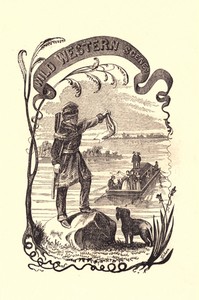
Wild Western Scenes A Narrative of Adventures in the Western Wilderness, Wherein the Exploits of Daniel Boone, the Great American Pioneer are Particularly Described — Inside the Classic
19
2
Project Gutenberg
2004
Western stories; Wilderness areas -- Fiction; Boone, Daniel, 1734-1820 -- Fiction
Readers of public-domain and historical texts
Project Gutenberg digital edition
en
Edition facts
Words: 102,223
Reading time: 445 min
Text sections: 18
Source:
Project Gutenberg record #13077
J.B. Jones's 1856 frontier novel blends autobiographical details with fictionalized exploits of Daniel Boone, featuring wolf hunts, a captive woman, and a haunted island dream sequence. The preface reveals the author's struggles to publish and his claim that many characters and events were drawn from his own Missouri exile.
Editorial Edition Score
4.8/5
★★★★★
★★★★★
Calculated from edition completeness, EPUB availability, text structure and catalogue metadata. Not a user rating.
Edition quality
J.B. Jones's preface to the fortieth edition of Wild Western Scenes is as revealing as the narrative itself. He confesses that the book was his 'first essay of an impetuous youth,' went unpublished for years, and finally appeared in a weekly newspaper before any publisher would touch it. The author insists that the scenery is 'a true picture,' several characters were 'real persons,' and many occurrences 'actually transpired in his presence.' Even the hero's dream of a haunted island was, Jones states, 'truly a dream of the author’s.' This editorial note examines the tensions between the book's autobiographical roots and its fictionalized frontier adventures, the contrasting portrayals of Mary and the male hunters, and the recurring pattern of pursuit and captivity that drives the plot.
Autobiography Disguised as Fiction
Jones's preface offers an unusually candid account of the book's origins. He describes his own 'voluntary exile in the wilds of Missouri,' paralleling his hero Glenn's experience. The author's struggle to find a publisher—he 'offered it for fifty dollars, but could find no purchaser at any price'—contrasts sharply with the book's eventual success, reaching its fortieth thousand. This backstory inflects the narrative with a personal urgency: the frontier dangers Jones describes are not merely imagined but drawn from his own observations. The preface also notes that the book 'has never been reviewed,' suggesting a defensive posture toward literary critics, whom he calls 'those who wield the cerebral scalpels.' Readers should note how the author's own biography shadows the fictional events, lending a documentary weight to scenes like the wolf hunt and Mary's capture.
Mary's Vulnerability and the Hunters' Agency
The excerpts present a stark contrast between the domestic sphere of Mary and the violent world of the male hunters. Mary is introduced 'singing over her neglected flowers,' tending to her fawn, and unaware of danger. Her thoughts are 'as pure as the morning dew,' and she knows no 'malicious enemy in the world, save the wild savage.' This innocence makes her capture all the more jarring. When the men return from the wolf hunt to find her gone, the emotional register shifts dramatically. Boone's reaction—'a ferocity from which even the blood-thirsty savages would have fled in horror'—and his vow that the ransom 'shall pay the weight of the silver they demand in blood' underscore the gendered division of roles: women are objects of protection and rescue, while men enact vengeance. The narrative's energy flows from this tension between pastoral tranquility and violent disruption.
Pursuit, Recapture, and the Pattern of Crisis
The chapter title 'Mary—Her meditations—Her capture—Her sad condition—Her mental sufferings—Her escape—Her recapture' telegraphs a repetitive cycle of crisis and relief that structures much of the book. This pattern is evident in the wolf hunt as well: the men pursue, kill, and return, only to discover a new emergency. The dogs' agitated behavior—'Ringwood running wildly about, whining and snarling and tearing the snow to pieces'—serves as an omen, heightening suspense before the revelation of Mary's absence. Boone's methodical response—calling her name 'three times, in clear and loud tones' and listening 'several minutes'—shows a character who alternates between controlled action and explosive rage. The excerpts do not reveal the outcome of the pursuit, but the structure suggests that each resolution will lead to another threat, keeping the narrative in a state of perpetual alert.
Readers approaching Wild Western Scenes should attend to the interplay between Jones's personal history and his fictional frontier. The preface provides a key to interpreting the novel as both adventure story and veiled memoir. Pay particular attention to the way domestic scenes are disrupted by violence, and how the characters' emotional responses—from Mary's innocent happiness to Boone's ferocious grief—drive the action. The book's episodic structure, with its repeated cycles of pursuit and capture, rewards a focus on the details of setting and the author's own commentary on his creative process.
Reader reflection
Record your reading impressions
A brief reflection can help important ideas stay with you longer.
Your progress
0
/
10
2
Did this book hold your interest?
3
How likely are you to recommend this book?
4
What was the reading difficulty like?
5
Could you apply anything you learned?
6
Did the book deliver what you hoped for?
7
Is this a title worth rereading?
8
What was the strongest part of the book?
9
What did this book teach you most?
10