
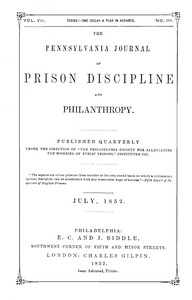
The Pennsylvania Journal of Prison Discipline and Philanthropy (Vol. VII, No.…
Let's be clear: this isn't a novel. You won't find a plot with a hero and a villain in the traditional sense. 'The Pennsylvania Journal of Prison Discipline and Philanthropy' is the real-time record of a moral revolution. Published by the Philadelphia Society for Alleviating the Miseries of Public Prisons, this volume from 1852 collects their reports, letters, and investigations.
The Story
The 'story' is the Society's ongoing mission. Think of them as early activists. They would visit prisons, document the filthy conditions, the idleness of inmates, and the brutal use of solitary confinement. Then, they'd publish their findings here. The journal details their arguments for separate cells, useful labor, basic education, and religious instruction—ideas that were radical at the time. You follow their work as they lobby the state, correspond with other reformers, and try to turn the grim reality of prisons like Philadelphia's Eastern State Penitentiary into something that might actually help, not just warehouse, human beings.
Why You Should Read It
I picked this up out of historical curiosity and was struck by how immediate it felt. The language is formal, but the emotion isn't. You can feel their frustration and their urgency in every page. Reading their detailed descriptions of overcrowding and disease makes our modern prison debates feel like a continuation, not a new conversation. It’s humbling and a bit haunting. This book removes the cushion of 170 years and shows you people trying to solve a massive problem with the tools they had. It makes you ask: What are we documenting today that will shock people in 2200?
Final Verdict
This is a specialist's book, but it's also for a very specific kind of curious reader. Perfect for history buffs, criminal justice students, or anyone interested in the roots of social reform. It's not a light read—you have to be willing to sit with some dense 19th-century prose and statistical reports. But if you want to understand where our ideas about prisons came from, and hear the voices of the first people who said 'this is cruel and we must do better,' this journal is an incredible primary source. It's the original meeting notes from the fight for a more humane system.
This text is dedicated to the public domain. Distribute this work to help spread literacy.
John Garcia
9 months agoHaving read the author's previous works, the way it challenges the status quo is both daring and well-supported. I'll be recommending this to my students and colleagues alike.
Michael Davis
11 months agoImpressive quality for a digital edition.
John Davis
1 year agoGiven the current trends in this field, the formatting on mobile devices is surprisingly crisp and clear. It cleared up a lot of the confusion I had previously.
Charles Smith
9 months agoA brilliant read that I finished in one sitting.






David Hernandez
1 year agoAs a professional in this niche, the way the author breaks down the core concepts is remarkably clear. Finally, a source that prioritizes accuracy over hype.