1

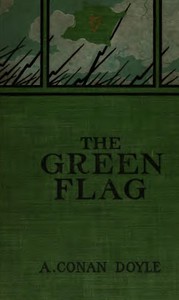
The Green Flag, and Other Stories of War and Sport — Reading Notes
758
2
Project Gutenberg
2003
War stories, English; Great Britain -- Social life and customs -- 19th century -- Fiction; Sports stories, English
Readers of public-domain and historical texts
Project Gutenberg digital edition
en
Edition facts
Words: 80,206
Reading time: 349 min
Text sections: 8
Source:
Project Gutenberg record #10446
Doyle's collection pairs Irish nationalist soldiers with French aristocrats seeking vengeance, using precise physical violence and ironic narration to explore loyalty, honor, and brutality in war and sport.
The collection opens with Dennis Conolly, an Irish nationalist who joins the British Army after his brother is shot, his "hot Celtic blood seethed with hatred against Britain." Doyle immediately establishes a tension between the recruit's private loyalties and his regimental duty, a theme that recurs across the eight stories. In "The Lord of Chateau Noir," a French count methodically recounts his son's mistreatment by a German officer, punctuating each humiliation with a physical blow to his listener. The narration is precise, almost clinical, in its depiction of violence, yet the dialogue carries an ironic, theatrical quality that undercuts the brutality.
Opening Gambits: Loyalty and Its Discontents
The first story, "The Green Flag," introduces Dennis Conolly as a member of C Company, described as "Celts, Catholics, and men of the tenant class to a man." Doyle uses the company's collective resentment—born of evictions and police violence—to frame the central conflict: soldiers who hate the flag they serve. The narrator notes that the Royal Mallows were "dry-rotted with treason," a metaphor that suggests internal decay rather than open rebellion. This opening establishes a pattern of ironic distance: the reader is told of disaffection while watching characters navigate military discipline. The excerpt does not reveal whether Conolly's hatred resolves or erupts, but the story's title—a green flag, symbol of Irish nationalism—hints at a symbolic confrontation.
The Structure of Revenge: A Tale Told in Blows
In "The Lord of Chateau Noir," the count narrates his son's captivity to a German officer, matching each recounted insult with a physical attack. The structure is symmetrical: the count says, "he struck him in the eye, like this!" and delivers the blow; later, he describes kicks and torn moustache hairs, each accompanied by a corresponding action. Doyle uses this repetitive pattern to create a ritualistic, almost legalistic vengeance. The German officer is reduced to a passive recipient, his protests ignored. The count's insistence on chronological order—"I am taking things in their order, just as they occurred"—gives the violence a cold, procedural logic. The excerpt breaks off before the story's conclusion, leaving the reader to wonder whether the count's recitation will end with a final, fatal blow.
Voice and Ironic Distance
Doyle's narrators often adopt a detached, slightly sardonic tone. In "The Green Flag," the description of Conolly as a recruit—"Seldom has Her Majesty had a less promising recruit"—is followed by a deadpan account of his physical qualifications: "6 ft. of brawn and his 44 in. chest." The juxtaposition of political unreliability and military utility creates an ironic gap between the character's inner world and the army's perception. Similarly, in "The Lord of Chateau Noir," the count's elaborate politeness—"Will you permit me to bind it with my silk handkerchief?"—contrasts with his violent actions. This verbal restraint heightens the horror, as the reader watches brutality delivered with courtesy. Doyle's dialogue carries the weight of the stories, often revealing character through what is left unsaid.
Setting as Psychological Pressure
The stories use confined, charged settings to intensify conflict. In "The Green Flag," the barracks and the Irish countryside are backdrops for simmering resentment; the "moonlight frolic" that kills Conolly's brother suggests a landscape of ambush and reprisal. "The Lord of Chateau Noir" takes place in a private dining room, where the count traps his German guest. The room becomes a theater of revenge, with the door closed and the wine poured. Doyle's descriptions are economical: the count "settled down in his chair once more" after a blow, a small gesture that signals control. The setting is not merely decorative but functional, shaping the power dynamics between characters. The excerpts do not reveal the full range of locations in the collection, but these two stories suggest a preference for intimate, pressure-cooker environments.
Readers approaching this collection should attend to Doyle's use of narrative voice: the ironic, understated tone often carries the moral weight of the stories. The violence is explicit but never gratuitous, always tied to character and consequence. Because the excerpts are incomplete, the resolution of each story remains unknown, but the patterns of loyalty, revenge, and honor are established early. Pay attention to how Doyle balances sympathy for his characters with a clear-eyed view of their actions.
Reader reflection
How did this book work for you?
Your answers remain private and are stored only in this browser.
Your progress
0
/
10
2
Did this book hold your interest?
3
Is this a title you would suggest to others?
4
How easy was the book to follow?
5
How strong was your personal connection to the text?
6
Did the book offer a fresh perspective?
7
Which element worked best for you?
8
How useful were the ideas in this book?
9
What did this book teach you most?
10